at262
Frank Denyer
Five Muted Quartets
Frank Denyer
Featuring: Frank Denyer Luna String Quartet
Available soon
Five Muted Quartets
1. String Quartet No 2 (2017/18)
2. String Quartet No 3 (2022)
3. String Quartet No 4 (2023)
4. String Quartet No 5 (2024)
5. String Quartet No 6 (2025)
Luna Quartet
Janneke van Prooijen - violin
Jellantsje de Vries - violin
Elisabeth Smalt - viola
Katharina Gross - cello
and
Diamanda Dramm - 2nd violin in Quartet No 2

Booklet Notes by Frank Denyer
The aim of many classical CDs is to whisk listeners away to concert halls with wonderful acoustics in faraway places. But for this CD I’d like to put the musicians in the room where you are now listening, and for you to hear them at a level that is comparable to that of easy conversation. They are not addressing a large audience, a crowd, but just other thoughtful individuals like you. It is an easy tone of voice in which not only ideas and feelings, but confidences can be shared (although perhaps some can still only be whispered). In these circumstances, any rhetoric or charisma is inappropriate.
These string quartets are a small attempt to rediscover the intimacy of ‘chamber’ music, a quality of communication that was lost in Europe during the 19th and 20th centuries as small scale performances migrated from private houses into larger public spaces, and subsequently, musical instruments had to be physically modified to make them louder. Today, now that for many of us recordings have become the primary source of our musical experiences, that intimate tone of music making can be re-discovered, but of course, it will be in new forms appropriate for the 21st century.
Today there is a constant demand for almost unlimited transparency, and the previously rigid demarcation lines between the private and public spheres have been eroded, particularly by social media. The commercial world imposes itself into our most private spaces and the online discourse it brings is angrier, ruder, and more vitriolic than ever. We are in danger of losing both domestic and public spaces that are reliably free from commercial intrusion. We need such spaces because this is where ideas can be quietly cultivated, where art can be shared between friends, and the inner life nurtured. Without it the scope of creativity diminishes until the only thing left is an endless stream of sensationalised streaming from a digital world. Culturally speaking, sharing secrets with those we trust, and safely guarding those we have been privileged to receive, is an essential part of the human experience. Therefore, it is incumbent upon us today to rearticulate and celebrate the private realm, even as we attempt to redefine it for our times.
Perhaps this gives the impression that these string quartets are primarily intended for recorded performance and private listening, but this is not so. As far as live performances are concerned, they are best in small, quiet venues that can allow a smallish audience to sit relatively close and on the same level as the musicians; rather than the musicians being isolated from them on a raised stage.
These compositions are part of a sequence that began with String Quartet No 2, which was recorded by the Luna Quartet and first released on The Boundaries of Intimacy (at148), and concludes with No 6. Although each quartet is a single movement, the intention is for a number of them to be heard sequentially, rather than being heard separately. Whatever selection is found appropriate for the occasion, they are best heard in the order in which they were composed.
The scores specify the use of ‘heavy’ mutes or ‘practice’ mutes, but the sound quality of the strings is altered in other ways too. The cello in Quartet No 3 and the viola in No 6 have certain notes and phrases that are distorted by the use of a metallic buzzer which gives them a raw, uncertain rasp, an effect you can hear on the first note of Quartet No 6.
Occasionally some subsidiary instruments are required. In Quartet 3, for instance, each player has a collection of around twenty pairs of small metal pellet bells which sound both singly and together. The second violinist and violist also have a slab of solid hardwood each, which they tap with the heal of the bow, and sometimes with their fingers. In Quartet 4 the first violinist, wears tap-dancers’ shoes (while still seated) which sound on a stone tile. The second violinist occasionally strikes a piece of non-resonant metal; the violist taps on a partly open cigar box. The cellist has a sharp thigh slap. At the climax, a number of other people join in, and the music for a few moments breaks through its conventionally accepted confines.
Quartets 5 and 6 are largely free from such auxiliary sounds, although in all the quartets the musicians are occasionally required to sing a note quietly as they play it, or sing instead of playing it, or sing another pitch to that played. They produce other vocal sounds as well.
Throughout the cycle the music is microtonal, but in Quartet 6 the viola’s D string is actually retuned 40 cents higher than usual. This helps stabilise some microtones, but the D quarter-sharp also acts as a recurring reference point for the listener, sounding a little louder than the surrounding notes. It is first heard at the beginning; indeed, it is the very first note.
Frank Denyer, June 2026

Quartet 2 recorded 30th May 2018 by Robert Bosch at Splendor, Amsterdam
Quartets 3-6 recorded 10th-13th February 2026, Robert Bosch Geluid, Amsterdam
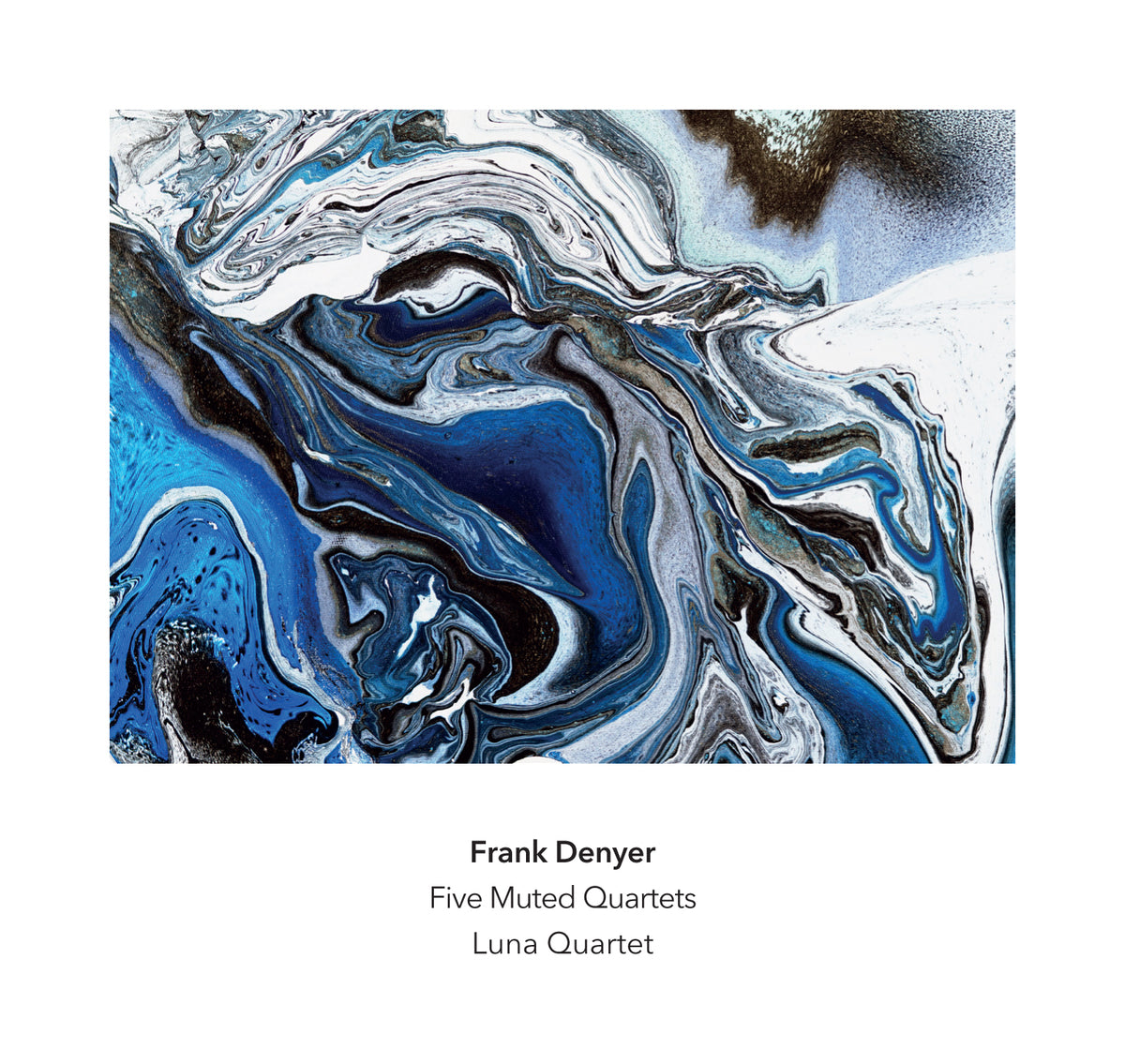
Cover artwork: detail from a painting titled Embody by Finlan Whelan
Photogrpah of Frank Denyer by Denis Avetisyan
Photograph of Luna Quartet by Ben Bonouvrier