at252
Klaus Lang
geschrieben in wasser
Klaus Lang
Featuring: Apartment House Klaus Lang
Couldn't load pickup availability
1 – weisse äpfel (2009) 19:57
Mira Benjamin, violin Bridget Carey, viola Anton Lukoszevieze, cello
2 – my heart is singing like a bird (2022) 14:28
Heather Roche, clarinet Mira Benjamin, violin
Anton Lukoszevieze, cello James Opstad, double bass
3 - die drei dirndln (2007) 10:32
Heather Roche, clarinet Mira Benjamin, violin Kerry Yong, piano
4 – aki (2019) 11:10
Kerry Yong, electric organ Michelle Hromin, clarinet
Heather Roche, bass clarinet Mira Benjamin, violin
5 – geschrieben in wasser (2007) 6:41
Kerry Yong, piano Mira Benjamin, violin
Bridget Carey, viola Anton Lukoszevieze, cello

Interview with Klaus Lang
'weisse äpfel', the string trio that starts the album, dates from nearly 20 years ago and is the longest piece on the album. I feel it contrasts intriguingly with the second track, 'my heart is singing like a bird', which is the most recent piece. While 'weisse äpfel' is quite textural, with pitches gradually emerging from a bed of noise, 'my heart is singing like a bird' is the most lyrical of the works, with the clarinet having a strong melodic line. Does the contrast between the two demonstrate a general change in the style of your music across this period? And also, what does the first piece have to do with white apples?
The development of Western music history is a quest for new sound structures driven by the curiosity of musicians and composers. The history of music is an everchanging process driven by the urge to uncover unchartered territories of sound. This path does not always lead forward or upward but also very often inward into the sound. The same perennial question presents itself today: In which direction should we continue. where can we find fresh approaches? where is today’s the cutting edge?
Today after a century of focus on the opening up of new musical material resulting in a century of noise and sound textures during which music integrated finally all possible sound structures from white noise to sine waves, for me finding new reiterations of sounds and techniques originating in the 20th century, is not viable any more.
The way out of this dead end is often to be found not in front of us but behind us. Often we have to turn back to find the continuation of our path: we can find the new in the re-interpretation of the past. This thought made me start looking more closely at pitch material, at interval structures, melodic as well as harmonic, and at medieval and Renaissance compositional techniques, trying to hear and use them differently.
This led me to rediscover an English group of artists who 200 years ago were trying something similar: the Pre-Raphaelites. The Poem My heart is like a singing bird by Christina Rossetti, one of the most important artists of this movement, is the basis of the second track on the album. When visiting the Victoria and Albert Museum I was happy to discover that the title of the rooms dedicated to the Pre-Raphaelites was ‘Beauty as Protest’. This points to two very important aspects of their art that are also essential to me as a composer.
As to the title of weisse äpfel, isn’t it really obvious that the piece has to be called “white apples”?
'die drei dirndln' is a beautiful minimal piece for clarinet and violin, with piano accompanying at the very beginning, and then soloing at the end for no apparent reason, except that it sounds great. Did you plan this unusual structure from the start, or did it just emerge as you were composing the piece?
During my compositional process the development of the formal architecture of the piece is a central part. All sounds or textures are not merely sound-effects; they are always structural elements used to create the temporal architecture that constitutes the piece of music.
'aki' has a different, fuller feel than most of the music on the album, largely because of the constant organ/harmonium part. Organ and harmonium are instruments that you play, and you have composed a lot for them. What is it that draws you to their sound? Also, what does ‘aki’ refer to?
There are two main aspects of harmonium and organ that fascinate and attract me. On the one hand their ability to sustain notes for a very long time - potentially endlessly - and time is the tool that opens up the interior of sound.
On the other hand sound production with these instruments is quite mechanical and doesn’t represent or require expression on the part of the player. On all other Instruments playing very loud or very soft implies always a bodily tension and a specific mindset that creates an expressive quality that is added willy-nilly to the sound produced. Very soft or very loud sounds tend to always include this extramusical component. In contrast both organ and harmonium can produce sound as sound in its purest form just because the mode of sound production, i.e. the minimal movement of a finger, is always identical.
aki means “autumn” in Japanese.
Basho:
かれ朶に
烏の とまりけり
秋の暮
a bare branch / a crow sitting / autumn twilight
I love the short coda at the end of 'geschrieben in wasser', when the music suddenly moves into a lighter, fleeter mode. For me that sort of unexpected shift in gear is a feature of your music, and gives it a lot of life and energy. Have you ever composed using systems/processes, or is that anathema to you?
In fact all my music uses very strict compositional structures and methods - my systems are my best friends. The second part of geschrieben in wasser is constructed as a 90° turn of the structure of the first section.
The piece is a homage to my favourite poet John Keats, and uses as its title words he had inscribed on his gravestone in Rome: "Here Lies One Whose Name was writ in Water"
Review by Dominic Hartley at Music Web International
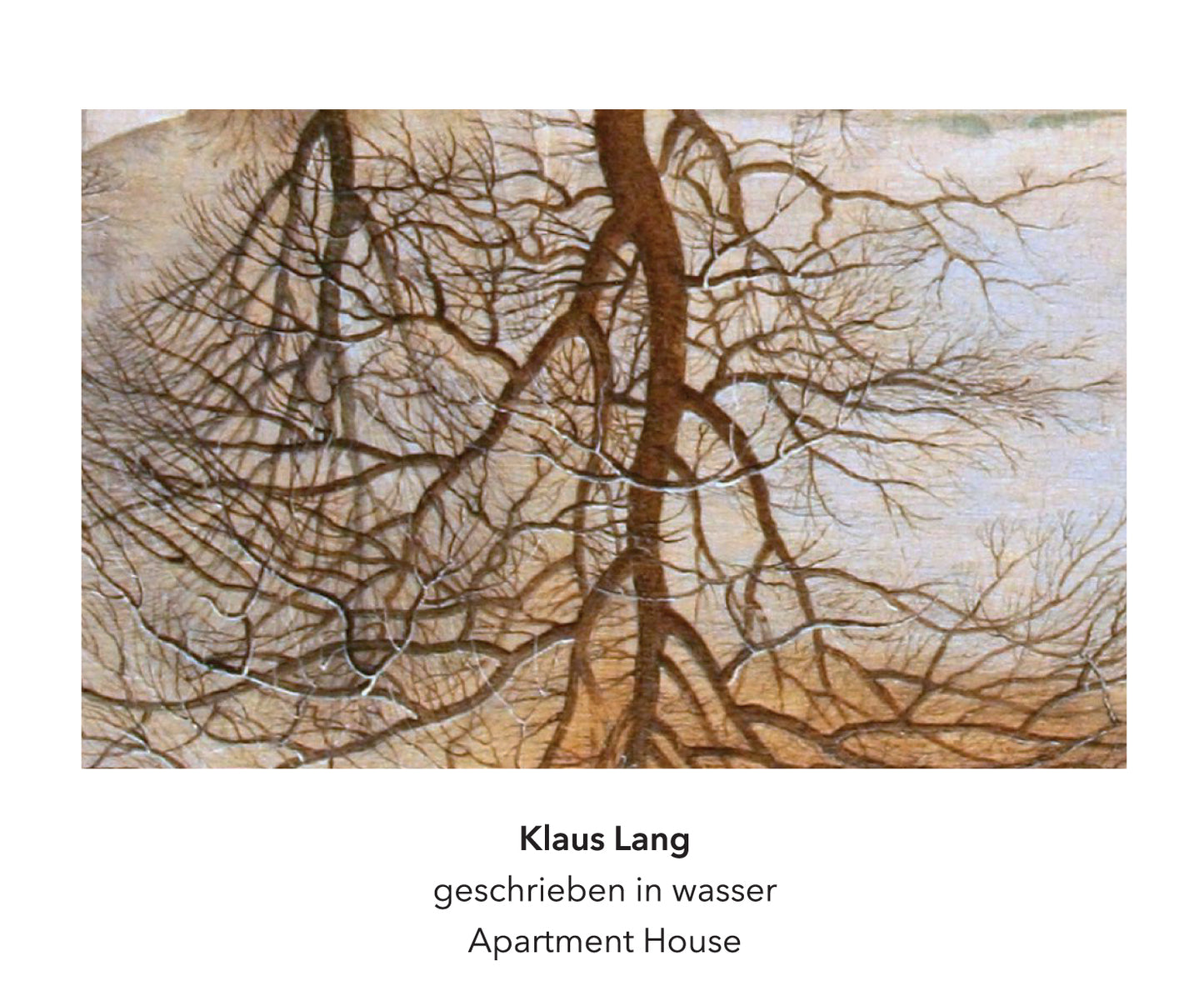
In an interesting interview accompanying this release, composer Klaus Lang is asked a question that crossed my mind more than once while listening to the first work, weisse äpfel: what does it have to do with white apples? Lang’s reply is wonderfully deadpan. Isn’t it really obvious, he says, that the piece has to be called ‘white apples’? It’s no answer at all, and that may be the point. The cover of the album reproduces a detail from Pieter Bruegel’s Winter Landscape with a Bird Trap, which only sharpens the question rather than answering it: bare branches against snow, no apples in sight, white or otherwise. One begins to suspect that Lang is enjoying himself, and that the joke — if it is a joke — is on those of us who keep asking what music is about.
Indeed, Lang’s music has eluded easy categorisation throughout his career. This new album is no exception, providing a fascinatingly varied selection of pieces for chamber ensemble, the excellent Apartment House. weisse äpfel is the longest work, just under twenty minutes, scored for string trio. A small handful of pitches become discernible as the music gets underway, and as it unfolds the harmonic field widens, the ear being slowly given more to hold onto. What carries the piece is a regular, almost respiratory pulse of short bowed swells separated by near-silence, the dynamic remarkably even. Bowed breathing, then. Mira Benjamin, Bridget Carey and Anton Lukoszevieze are rock solid here, sustaining a discipline of articulation and dynamic that never wavers across nearly twenty minutes — the kind of playing that draws no attention to itself precisely because the music demands that it shouldn’t.
my heart is singing like a bird, the next piece, dates from 2022 and reflects a more recent preoccupation. Lang tells Simon Reynell, ‘finding new reiterations of sounds and techniques originating in the 20th century, is not viable any more. The way out of this dead end is often to be found not in front of us but behind us.’ His ‘way out’ has been to study the Pre-Raphaelites, and specifically Christina Rossetti, whose poem ‘A Birthday’ opens with the line ‘My heart is like a singing bird’. The piece takes its title from that line, slightly altered, and the textural conceit is direct enough that one hears it almost immediately: Heather Roche’s clarinet is the singing bird, and the cello and double bass beneath her — Lukoszevieze again, with James Opstad — provide the continuous ground of branch and air on which the bird is perched. Mira Benjamin’s violin moves between the two, sometimes joining the melody, sometimes dropping into the supporting texture. It’s a gem. Serendipitously I came to this release having just reviewed the glorious Clarinet Quintet by Jürg Frey (also featuring Roche, Benjamin and Lukoszevieze) and the contrast is instructive. Where Frey works through restraint and implication, Lang is more overtly lyrical in this far shorter work, but both composers give one a welcome sense of warmth, contemplation and release.
Die drei dirndln (‘the three lasses’) has a particularly unusual structure. For roughly the first four minutes, clarinet, violin and piano coexist in a sustained, slow-moving texture in which the piano interjects only sparingly, sharp and discrete against the longer bowed and blown lines. Then, gradually but unmistakably, the balance tips: the piano’s interjections become more frequent and more weighted, the sustained writing for clarinet and violin thins out, and by around the five-and-a-half-minute mark Heather Roche and Mira Benjamin have receded almost entirely, leaving Kerry Yong’s piano to carry the rest of the piece more or less alone. The piano has been there throughout, but the piece works as a slow gradient of dominance, the centre of gravity migrating from the ensemble to a single instrument. The ‘three lasses’ of the title presumably correspond to the three instruments, but the procedure is more subtle than a simple subtraction; one of them outlasts the others by being patient. As ever the playing is unimpeachable, and Yong’s solo passages at the end have the alertness of someone who knows exactly how much air is around each note.
Aki — the Japanese word for autumn — takes its cue from Bashō’s famous haiku of a crow alighting on a bare branch at autumn twilight. It is, again, different from anything else on the album. Kerry Yong moves to electric organ, and from about a minute in he plants a low D that runs almost unbroken to the end of the piece — like the line of the horizon, audible the whole way through. The two clarinets (Roche and Michelle Hromin) and Benjamin’s violin articulate above this drone in phrases that come and go, settle and resettle, never quite arriving and never quite departing. If Bashō’s haiku is about the moment in which a single image — crow, branch, twilight — becomes sufficient, then aki is the musical analogue. It is a piece about patience, perhaps, and about being at peace with not arriving.
The shortest piece on the album closes it: geschrieben in wasser, just under seven minutes for piano quartet. The title is taken from the inscription on John Keats’s gravestone in Rome — ‘Here lies one whose name was writ in water’ — and the homage is real, but I would not press the watery metaphor too far where the music is concerned, because what geschrieben in wasser offers is one of the most clearly articulated structures on the disc. Lang has spoken of the piece’s second part as a ninety-degree rotation of the structure of the first, and you can hear the rotation point: at around three minutes and twenty seconds — almost exactly the midpoint of the body of the piece, before the coda — the texture changes character. Before the hinge, the writing is articulated and event-based, the piano leading and the strings entering between attacks; after it, the texture becomes continuous, denser, and more sustained, the strings now carrying the weight and the piano embedded in a fuller fabric. Then, in the last thirty seconds or so, a brief lull and a coda that shifts again into something brighter and fleeter. For a Keats homage, the formal clarity is striking.
It is worth standing back at this point and saying something about the album as a whole, because the sequencing repays attention. These five pieces span fifteen years, from the two 2007 works to my heart is singing like a bird in 2022. They are not presented chronologically, but rather one comes to feel, by texture and by scale: the longest and most patient piece opens (weisse äpfel, nineteen minutes of bowed breathing), the most lyrical and the one most directly in dialogue with a literary source follows (my heart…, fourteen minutes of clarinet song over sustained ground), and then we get two middle-length pieces of contrasting architecture — die drei dirndln with its migrating centre of gravity, aki with its single sustained horizon — before the album closes with the shortest and most compressed of the five, the piece in which the formal procedures are at their most explicit. The trajectory is from extensive to intensive, and it works beautifully.
Dominic Hartley