at251x6
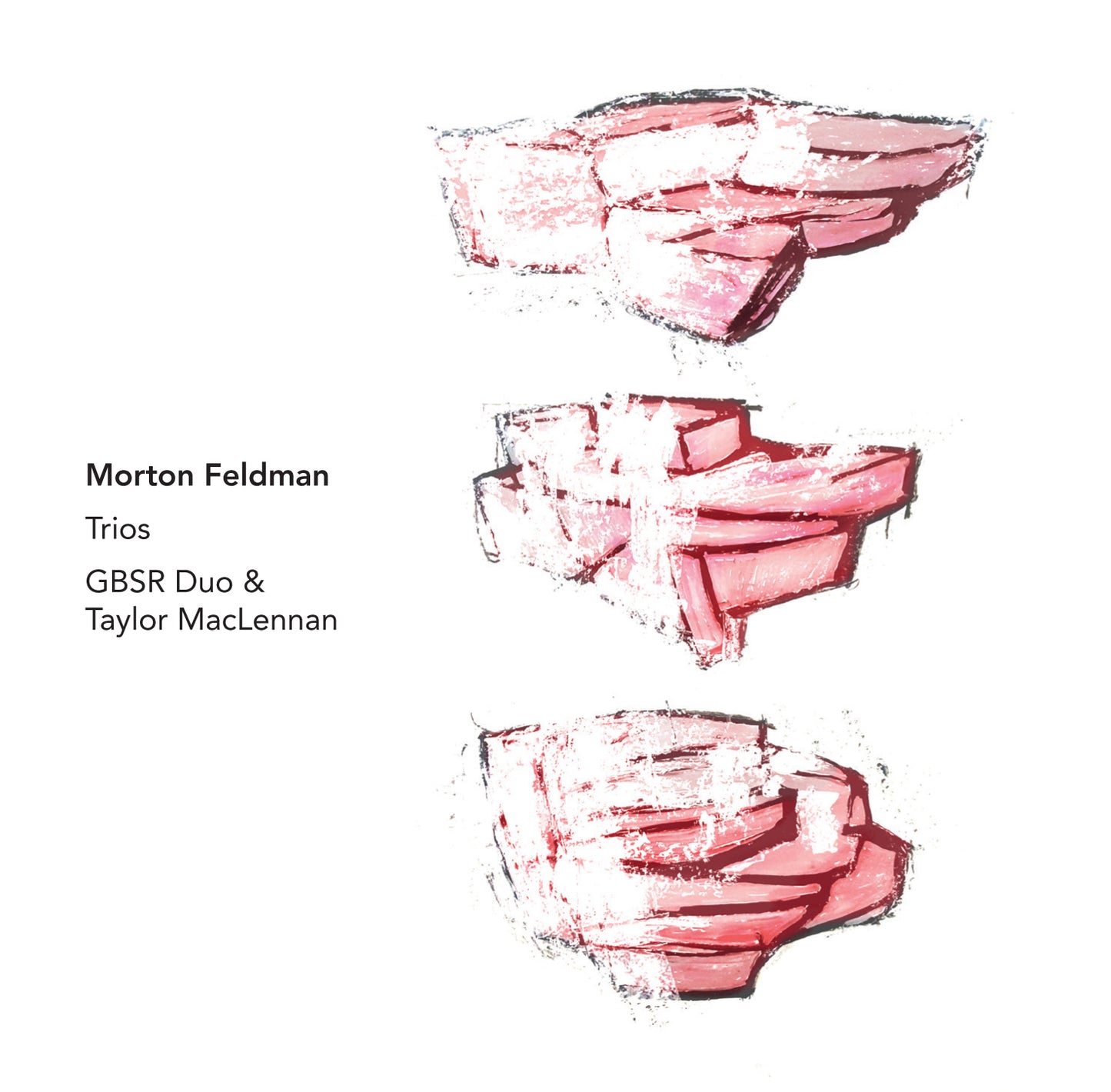
Morton Feldman Trios box set
GBSR Duo with Taylor MacLennan
Morton Feldman Trios box set
Featuring: GBSR Duo Morton Feldman
Couldn't load pickup availability
1 Why Patterns? (1978) 29:55
Taylor MacLennan, flutes Siwan Rhys, piano George Barton, glockenspiel
2 Crippled Symmetry (1983) 90:47
Taylor MacLennan, flute & bass flute Siwan Rhys, piano & celesta
George Barton, vibraphone & glockenspiel
3 For Philip Guston (1984) 281:30
Taylor MacLennan, flutes & piccolo Siwan Rhys, piano & celesta
George Barton, vibraphone, glockenspiel, marimba & tubular bells
Three massive late works by Feldman, totalling six and a half hours of music.

Interview with the musicians by Marat Ingeldeev
As we mark Feldman’s centenary, do you remember how you first came across his music and what impression it made on you?
George: I was first introduced to it in my late teens, at school. My music teacher, Sinan Savaşkan, was a devotee of Feldman’s music and played us Madame Press Died Last Week at Ninety and excerpts from Rothko Chapel in class. The idea was to explain the Darmstadt school by contrast, holding Feldman up as a kind of anti-Boulez or anti-Stockhausen figure in terms of, among other things, working with intuition as opposed to system. I found there to be something mysterious and seductive about the music; its rich tactility was a revelation.
Siwan: I first came across Feldman’s music thanks to George. While we were both students at the Guildhall School, George put out a notice for willing pianists to perform For Philip Guston—literally ‘pianists’ because he’d been advised that, due to the length of the piece, the job should be shared by more than one student. This is how we met and For Philip Guston is one of the very first pieces we played together. We ignored the advice to use more than one player and I’m very glad we did, because the grand scale of the work gave me a particularly intense and immersive first experience. My memories of my early impressions of Feldman’s music are hazy and more tactile than anything else. I do remember loving the then unusual experience of being inside a piece for such a great length of time. The focus and long duration make it feel like a room around you, and maybe because of the particular shape and pacing there’s scope to observe and take in the room a little more than with other music, which I find an extremely rich musical experience.
Taylor: I first heard Feldman’s music as a first-year student at the Royal College of Music, during a lecture where Rothko Chapel was played. I had never heard anything remotely like this music, and I remember being struck by how hauntingly beautiful it was.
Has your perception of Feldman’s music changed over the years of listening or performing it?
Siwan: In my first years of getting to know it, I heard and played a lot of his later works, and mistakenly assumed that much of the rest of his output would be similarly quiet, resonant, obsessive and long-form. In recent years, mainly thanks to Philip Thomas’ Feldman piano music recordings, I discovered his earlier work with all its variety and curiousness and realised that there were many more worlds than I had first imagined. So in this way, my perception has changed as I’ve learnt or heard more of it. Returning to the pieces I had previously played to record them for this box set felt very much like stepping back in time, or into a familiar room.
George: I don’t think my perception of the fundamentals of Feldman’s music, or perhaps of the fundamentals of what draws me to it, has changed greatly over the years. Listening to and reading the scores, as well as Feldman’s writings and interviews, has given a deeper understanding of how he fits into musical history and of how he arrived at his compositional decisions. There is also a trap here which many have observed when working on his pieces: his own statements on his music are frequently intentionally obfuscatory, frustrating earnest attempts to grasp the motivations behind them with deliberate cuteness. As a result, I find myself having to wean myself from the impulse to seek documentary evidence for interpretative decisions, instead returning to my instinctive sense of what to prioritise as a performer.
Taylor: The first time I had the opportunity to perform Feldman’s work was in 2022 with George and Siwan, when we played Crippled Symmetry in Sheffield Cathedral (I believe Simon Reynell was in the audience, and perhaps this performance planted the seed for this box set). Performing it was a truly memorable and rewarding experience for me. However, it gave me a false sense of security before tackling For Philip Guston. Of course it is three times as long, but it also demands a completely different mindset due to its rhythmic and ensemble challenges, alongside the need to maintain control of your instrument at the very softest end of your dynamic range. My perception of performing Feldman’s music certainly changed after understanding the challenges of For Philip Guston.
What was the recording process for this box set like, and how did you tackle For Philip Guston given its four-hour duration?
Taylor: We recorded a couple of versions of Why Patterns? and Crippled Symmetry as these could only be captured in full takes due to the compositional nature of these pieces. This made the recording process for these works somewhat anxiety-inducing. The thought of potentially ‘ruining’ a complete take of the 1.5-hour Crippled Symmetry weighed heavily on my mind at times. Fortunately, complete takes of For Philip Guston were unnecessary.
George: Inevitably you have to break up pieces when recording—performing complete takes of For Philip Guston would not be practical. But because so much resonance hangs over the entire work, editing can also be difficult. As a result we sometimes played long passages of music in a take, twenty minutes to half an hour. When it’s working, something of the mindset from performing the whole span of the piece, the strange feeling of immersion (or submersion!), begins to take hold.
Siwan: One of the biggest challenges over the three days we spent recording For Philip Guston was maintaining concentration and taking care of physical fatigue, as playing very quietly and very rhythmically for extended periods can be quite physically and mentally taxing. This is hard to do while also balancing the strong desire to get under the music’s skin and play long stretches of this very absorbing material, so we had to be quite disciplined about take lengths. There were however a few long passages where, as we played, we all felt something was right and flowing well, and so continued for much longer than planned—one of the great things about working with Simon Reynell is that he also senses when one of these ‘magic takes’ is happening and knows when to allow things to continue.
George: It’s also very hard to record quiet. In practical terms that’s because someone opening a door somewhere else in the building could ruin a take. But more importantly, playing quietly into a microphone can actually increase the perceived body of a sound if it is then amplified too loudly (this is how the Hollywood/Hans Zimmer ‘oof’ bass drum sound is made!). Luckily, Simon is a past master at recording quiet music—he manages to convey through the recording a sense of the actual volume in the room, perhaps something to do with his background in documentary.
Both Why Patterns? and Crippled Symmetry rely on independently moving parts, with each performer following their own line. For Philip Guston, by contrast, is tightly fixed and unfolds on a much larger timescale. How do these different approaches feel from the player’s perspective?
Siwan: All three works require a strong focus on sound production, control and very precise rhythmic placement, but it’s perhaps surprising how strongly a shift in style or system of notation (FPG vs WP/CS) can affect the approach without necessarily changing the overall sonic result. The way of performing Why Patterns? and Crippled Symmetry can be much more inwardly focused. There’s no need to maintain such a keen awareness of where your colleagues are in terms of alignment. There’s perhaps a bit more space for playfulness.
Taylor: Performing Why Patterns? and Crippled Symmetry is quite a freeing experience for me. Even though Feldman’s material is highly specific in terms of pitch and rhythm, there’s a sense of being on your own trajectory. You can fully inhabit your own sound as well as the collective, whilst enjoying the serendipity of unexpected alignments or fresh perspectives between the three instrumental lines.
George: In the case of For Philip Guston, the performer’s focus is more communal due to the complicated rhythmic interactions between those horizontal lines. It’s a very delicate balance, almost as though each player is blowing gently through a straw to keep a very light and fragile object suspended between us—you have to match your colleagues exactly or the object becomes destabilised. The timescale merely adds another layer of difficulty because you can’t really afford to lose focus on this shared sound object, but maintaining it over four and a half hours is a difficult game of self-management. The brief moments when you are able to rest and reset become very important.
Taylor: Beyond the sheer duration and stamina required, the real challenge lies in sustaining the sublime atmosphere Feldman conjures, without showing the effort required to execute the material. When you factor in the extreme length of the work, it becomes quite a daunting task which demands more from you than anything else I’ve played. The payoff is completely worth it though.
The launch of the box set will take place on Sunday 18 January 2026 at Kings Place in London, where you will perform the whole of For Philip Guston—no takes, no breaks. How do you mentally and physically prepare for such a long, continuous performance?
Siwan: Aside from keeping an eye on my liquid intake just before the concert, most of my preparation beforehand will be reminding myself that I can trust myself to play the music. I care a lot about the piece, and it’s sometimes easy to get carried away with worries about whether we’ll do it justice. Of course we’ll rehearse it until it feels as bulletproof as it can, but with the knowledge from having performed it before that there will be moments when fatigue sets in and concentration lapses, or the back starts to hurt—those come and go, and there will also be moments of focus and elation.
Taylor: I’ve not had the experience of performing For Philip Guston, so I find it reassuring to be partnered with Siwan and George for this concert. They bring a profound understanding of this music, along with their unique connection as a musical unit, and I feel honoured to be invited to take part. My preparation has focused on immersing myself in the score and becoming accustomed to playing through extended sections of the piece. Physically, it has involved building stamina and finding ways to stay relaxed and economical over the course of it. It is still difficult to imagine what it will feel like to play the work from start to finish in performance—no takes, no breaks. The scale is hard to comprehend. Rather than thinking in terms of minutes and hours passing, I’m trying to approach it as a single, immersive event, one in which the outside world is shut out and time effectively stops. I’m sure I will experience a wide range of thoughts and emotions, alongside the inevitable aches and pains, but I am equally sure that I will emerge from the other end changed in some way.
George: It’s partly a question of balancing priorities in rehearsal. On the one hand, the piece is rich with detail and contains many difficult or fiddly passages. You have to do the normal rehearsal thing and hone in on those, especially knowing that in performance you may already be fatigued, having played long stretches of music where you are moving, counting and generally thinking at a much slower pace. At the same time, you have to use the rehearsal time for training—actually getting used to the feeling of playing for extended periods, experiencing your mental energy waxing and waning. The passing of time is such a feature of Feldman’s music that learning to experience it, by doing, is a key part of accessing the essence of the work, rather than merely an incidental requirement of its length. In that sense, for all that it presents challenges and can even feel arduous at times, it’s also a privilege.
Siwan: After having recorded the piece, where we got to repeat material as much as we wanted or needed, it will feel very different to follow the inevitable forward line of performing it, and to throw notes and chords into the ether never to hear them back again. There’s something I quite like about sitting at the piano and settling in for a long-haul piece. The piano feels more like home than ever in those moments and I’m sure the audience will also be doing a similar sort of settling in. We’ll be sharing a musical experience over such a long duration—I always feel that creates a special bond between audience and performers—and I’m looking forward to that feeling very much.
Review from The Wire by Julian Cowley
At the time of his death in 1987 the discography of Morton Feldman remained slight. Ironically within a few years it saw rapid expansion, as the compact disc superseded vinyl. Today, the CD is widely regarded as a transitional format but, as this box set confirms, it still suits exceptionally well the long, quietly unfolding, texturally transparent and delicately detailed compositions of Feldman's later years.
Werner Uehlinger was quick to recognise the fact, and early in the 1990s his hatART imprint issued revelatory recordings of Crippled Symmetry, Why Patterns? and For Philip Guston, all scored for piano and celesta, percussion and flute. The extended length of play, expanded sound range and acoustic clarity of the CD allowed these extraordinary compositions to work their gentle magic with minimal disruption. No need to flip the disc after 20 minutes; no unwanted distortion, or distracting clicks and crackles.
All three of those pieces resurface here, sounding at home in the context of Simon Reynell's Another Timbre catalogue. The HatART recordings featured musicians whose close work with Feldman over several years had helped to inspire their composition and determine their distinctive instrumentation. Now, the performers are flautist Taylor MacLennan and GBSR Duo's pianist Siwan Rhys and percussionist George Barton, marvellous players who bring their own tact and understanding to the conceptual sophistication that underlies this music's appearance of simplicity.
Faithful translation of Feldman's intricately notated scores into floating tapestries of beguiling sounds involves sustained intensity of focus, an array of highly disciplined techniques and large reserves of stamina. It's a measure of the success of MacLennan and GBSR Duo, however, that their involvement as performers becomes, after a relatively short time, in each case, curiously easy to overlook. Their virtuosity is required to show discretion, to shun flamboyance.
Each composition appears to take on a life of its own, to become a self-sustaining environmental feature, rather like an abstract painting, hanging on a wall, subliminally altering the mood of a room, or like one of those finely woven Anatolian rugs that Feldman himself admired and studied closely. These are lengthy works. For Philip Guston is epic in duration, occupying four discs. Yet, in spite of their scale, in substance Feldman's compositions are the antithesis of monumental art. They seem to be designed not to commemorate themselves, but to become embedded within our lives, quietly persistent and unobtrusively radiant.
The abstract canvasses of Guston, along with those of Mark Rothko, inspired the composer to pursue a comparable air of stasis, in an artform defined by its temporal nature. Pattern and scale, together, enabled him to fulfil that apparently quixotic aspiration and, with the help of dedicated trios, to create music of luminous beauty. Julian Cowley