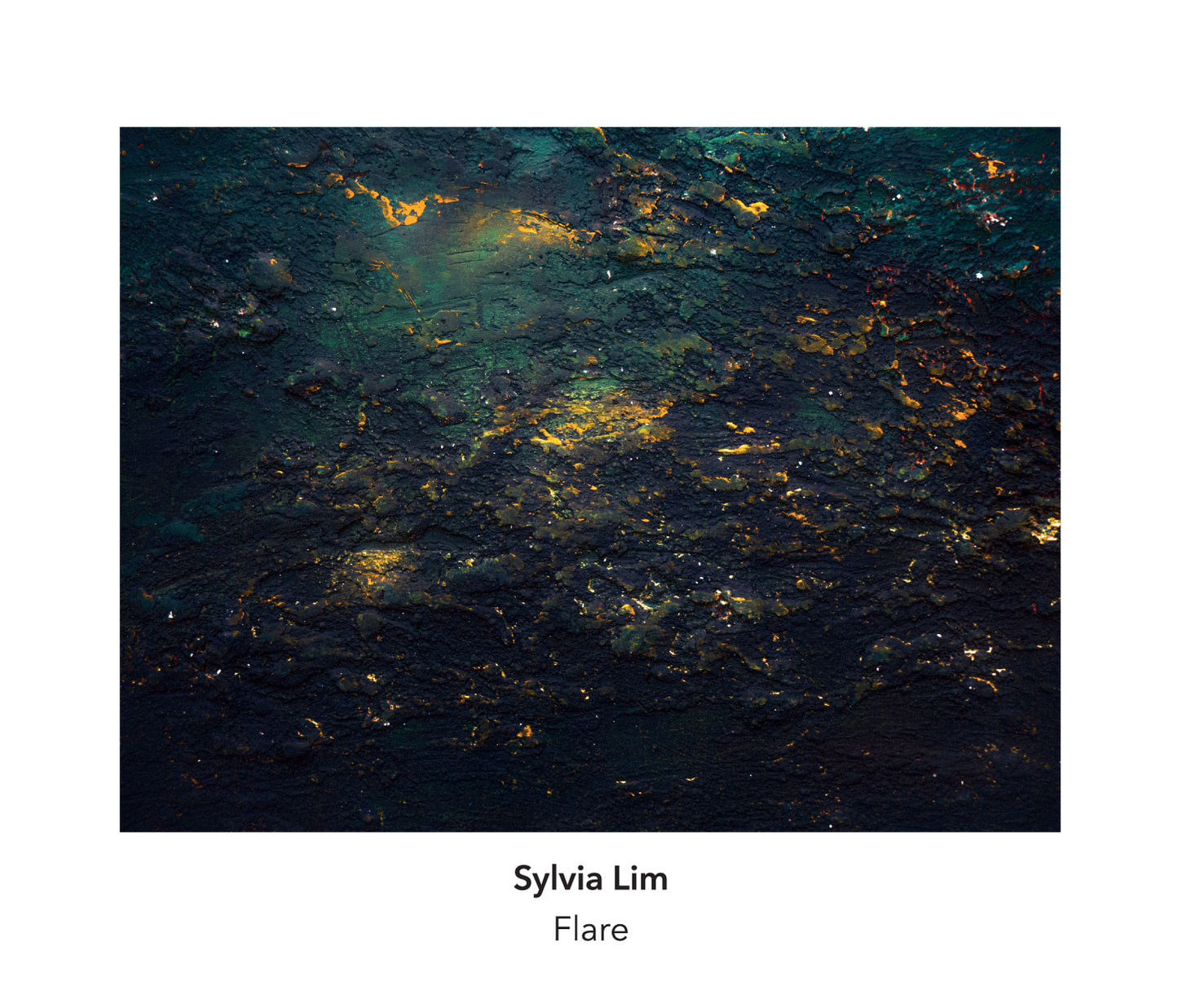
at255
Sylvia Lim
Flare
Sylvia Lim
Featuring: Sylvia Lim
Couldn't load pickup availability
1 shadowfolds (2025) 7:04
Kerry Yong, piano Simon Limbrick, vibraphone Mira Benjamin, violin
Michelle Hromin, clarinet Natasha Zielazinski, cello
2 flare (2021) 6:50
Ben Smith, piano
3 things we overheard (2023) 4:51
Simon Limbrick, vibraphone & percussion
Mira Benjamin, violin Michelle Hromin, clarinet Heather Roche, bass clarinet
4-5 same but different (2021) 9:45
Miyabi Duo: Hugh Millington & Saki Kato, guitars
6-7 Grafting (2025) 12:43
Mira Benjamin, violin Heather Roche, bass clarinet Natasha Zielazinski, cello
8-11 Field of Play (2024-2025) 18:29
8. hidden place 9. seesaw A 10. contact 11. seesaw B
Natasha Zielazinski, co-composer, cello

Interview with Sylvia Lim
Before we discuss the music on your CD, can you tell us a bit about your background: where you come from, how you came to experimental / contemporary music, where you studied, & where you're based now?
I’m currently based in London. I moved here to study composition at the Guildhall School of Music & Drama after finishing school. Before that I had spent equal parts growing up in Petaling Jaya, Malaysia and Sydney, Australia. At school my music was mostly influenced by musical theatre and Australian contemporary choral music, but at Guildhall things shifted as I encountered the diverse interests of staff and students. During my undergraduate studies I remember getting very excited when James Saunders gave a guest seminar and mentioned how a very slow bow speed on a string instrument could affect the stability of the sound - this was so new to me and I loved it. I was also really struck by the beautifully delicate world of Edmund Finnis’s Unfolds which had a huge impact on me at the time. I became increasingly drawn to unstable and fragile sounds as a way of exploring my own experiences of migration and change, which developed into a PhD on decay. Now I’d say my practice is shifting yet again and I hope it will continue to do so!
An interest in and exploration of fragility is certainly evident in the music on your CD, but can you say more about the current / latest shift in your music? How would you characterise it, and do any of the pieces on the album exemplify this?
During my PhD I became interested in more dynamic processes of decay (e.g. growth within decay), moving away from fragility as solely approaching emptiness or absence. This feels important to mention because it led to a preoccupation with timbral richness. The pieces on this album were written in the years following this. They reflect a deeper exploration of timbre, and consider how form and notation might emerge from the specific materiality of the sound rather than predetermined conceptual framings. For instance, flare explores the harmonics of just two keys on the piano, and in same but different, one of the guitars is prepared with a cotton bud. Writing these pieces involved working out what the possibilities were within those defined parameters, and listening attentively to what the sounds needed, which I think more frequently led me to places I was not expecting. I’d say the more recent pieces on the album (Field of Play, Grafting) take this further. The exception to this approach is things we overheard, where the sounds are very open-ended and loosely defined - the players respond to field recordings which they listen to privately while playing.
Yes, so focusing in on the music on the album, can we start with the last track, the cello solo, Field of Play, which was the kind of starting point for the CD as it was the first piece you sent me? On the cover you credit Natasha Zielazinski not just as the cellist, but as co-composer. Could you explain how the piece came about, and why you wanted to give Natasha this additional credit?
I met Natasha Zielazinski while I was a student at Guildhall (she was a mentor on a project). Over the past ten years we’ve been working together on new pieces in various contexts, having discovered a shared interest in certain kinds of sounds and ways of making. A few years ago I became very interested in instrumental preparations, after hearing Angharad Davies preparing her violin with a nail file at IKLECTIK. I loved how the instrument could take on this new richness, as though tapping into another reservoir of coloristic possibility. Some of these sounds are so complex and otherworldly, while at the same time foregrounding the very physical materials and ways in which they are being produced. I started exploring preparations in more depth in my other work, but also separately with Natasha.
Field of Play is a collection of pieces, with each one exploring a single preparation - a butterfly hair clip (hidden place), a bobby pin (contact), and a piece of cork (seesaw A & B). We were led by our curiosity and intuition, our questions which emerged in the moment and our constant reorientation as we tried to understand what we were doing. Each sound suggested its own world and form, its own imagery and processes.
From the start of the project, we wanted to see what would happen if we both shared the creative responsibility for decision-making. This was a new dynamic for us, although it felt like an extension of how we were working together before. It was a joint practice in which we brainstormed and reflected together, and compared our own ‘maps’/ documentation of our materials to see how we were individually understanding the sounds we were working with. The project was as much about exploring preparations as well as finding new methods for us to work together. Meeting in the home for more extended periods of time (with our routine of making salad or soup for lunch) allowed our project to intersect with home life, which informed the work (e.g. the butterfly hair clip we used belongs to Natasha’s daughter).
Great. I also really like the first piece on the CD – shadowfolds. Could you say a bit about what were you looking for there?
I was responding to your invitation to create a new piece exploring polyphony with a slightly larger ensemble to balance out the other pieces in the album. It was an appealing challenge, since polyphony doesn’t usually feature in my music, and I thought it could push me in new directions.
I wanted to explore lines that were more to do with timbre and the physicality of the instrument rather than pitch or melody. I was more interested in the overall sonority, the artefacts that are created through the interaction of the lines (beating, microtonal shifting, resonance), the sonic detail and atmosphere. I didn’t want the lines to go anywhere, but to simply inhabit a space.
The title is borrowed from a fabric art technique called shadowfolds, developed by the artist Chris K. Palmer, in which cloth is sewn to create geometric folds that play with shadow and light. In my piece the lines are more like shadows or blurrings, fragile and translucent, marked across the form through subtle repetition. Although my encounter with this technique came after the piece was written, I feel that it shares deep connections with the ideas I was trying to convey.
At first I was intimidated by the craft and history behind polyphony, but found it helpful to consider works that were, to me, rooted in a sense of intimacy and simplicity (e.g. Cassandra Miller’s Thanksong, the first movement of James Weeks’s Leafleoht, Grisey’s spectral polyphony, multi-screen installations by visual artists Bill Viola and Allison Chhorn, etc.). I wanted my approach to reflect something personal, something to do with vulnerability, tenderness and care. In the end what felt most intuitive to me was working outwards from multiphonics, harmonics, and other instrument-specific gestures, and getting hands-on with the instruments where possible so I could still feel that physical connection in my body.
That’s really interesting. Finally, I want to ask about the shape of the album as a whole because I find the movement across the course of the disc compelling. While – as you’ve said – a lot of the music is quite fragile, a couple of the earlier pieces – the title track Flare and the guitar duo same but different are nonetheless relatively upbeat and lively. Then there’s Grafting – the trio for violin, bass clarinet and cello, the penultimate piece, which is in two movements. The first movement is - once again - quite fragile, but also at times rather luscious with fragments of melody drifting through. The second, shorter movement is even softer, but also bleaker in that the lusciousness has given way to a more barren, strangled soundworld. This is followed by the last track - the solo cello piece, Field of Play – which is even more hushed and similarly bleak. Overall it gives me the sense of the music across the album slowly disintegrating into a kind of despairing near-silence. I find it really sad, even unforgiving, but remarkably effective aesthetically. Do you find this too when you listen to the album as a whole, and was it something you had in mind from the start, or did it just emerge as the pieces were assembled together?
The shape of the album emerged as the pieces were assembled together. I know what you mean, there does seem to be a shift from the second movement of Grafting. While composing this movement I was aware that it sounded closer to the world of Field of Play, since in the bass clarinet and violin we hear a very exposed, collective recreation of the cello’s sound (the cello is prepared with a cotton bud). Grafting as a whole was born out of a failed piece from Field of Play that never made it onto the album. It uses only one sound from the original (that you hear at the start of movement 1), but in a new context that as you say, is more melodic in the first movement.
So in listening to the second movement of Grafting and Field of Play I do sense the bleakness you mention, although I feel that this comes through more in the overall context of the album, and differs from the compositional preoccupations at the time. This is particularly true for Field of Play, which to me is nocturnal and subterraneous, but also playful, even hopeful and full of possibility. But within the context of the album, yes, seesaw A & B (Field of Play) in particular feel like disintegrated versions of flare and same but different, alluding to some of the warmth (from the fifths) but only in a sparse and fragile way. Whether bleak or not, perhaps this shift you mention is more of an invitation for a different kind of listening, a zooming in to a more microscopic world.
Review by Peter Margasak,
from Bandcamp's Best Contemporary Classical Releases, April 2026
This stunning new collection of works by the young London-based Malaysian-Australian composer Sylvia Lim is very clearly guided by the materials used in her measured, thoughtful writing. She worked closely with the members of Apartment House in discovering specific, highly specialized sounds and techniques from which she built her compositions, which generally rely on tiny gestures and a limited palate. But one listen to a piece like “Flare,” which exploits a stunning range of textures, rhythms, and harmonics from just two piano notes, proves that she doesn’t need more than that. Pianist Ben Smith produces a lively spray of damped notes that shift constantly over the piece’s seven minutes, endlessly reconfiguring the overtones—the primary texture we hear—through the interplay of each note so that it becomes easy to overlook how minimal the music actually is. Lim has a predilection for fragility, asking musicians to produce sounds that feel brittle and on the edge of disintegration, a quality that imparts a hushed intimacy. That quality serves the two movements of “same but different well,” as Miyabi Duo (acoustic guitarists Hugh Millington & Saki Kato) navigate the divide between tuneful fragmentation and extended techniques that suggest a diet of Derek Bailey, generating a lovely tension and leaving the listener uncertain of which side they should lean into. Lim retains this process for the chamber-oriented pieces like “Grafting” expertly balancing lyricism and color. I remember Lim’s promise on her 2022 album sounds which grow richer as they decay—Flare proves it’s been realized.
And there's a great extended interview with Sylvia Lim about her work by Tim Rutherford Johnson in his Purposeful Listening series, which you can read here