Another Timbre TimHarrisonbre
Interview with Chris Burn on the release of 'The Middle Distance'
When did you start playing piano, and what or who were your early passions or influences?
I began playing piano aged nine. Before that I had learnt trumpet from the age of six and subsequently guitar. I'm so glad that you separate passions from influences. Two very different concepts in my opinion. I could give you a long list of my early musical experiences and passions; what, if any influence these had on me, I wouldn't like to say. I have fond memories of the brass band I played in from age 6 playing Wagner arrangements, marches and tunes such as Barwick Green ( the Archers theme tune). I also have very early memories of, whenever possible, trying out the piano in my grandmother’s front room. This instrument was subsequently given to me and I played it for nearly twenty years. It was over a semitone flat and because of its age, it remained that way. This has given me an unusual sense of pitch, furthered by the fact that my current piano also has a similarly lowered pitch.
Early teens saw me introduced to Coltrane and Coleman along with the usual progressive rock stuff and a large amount of music from the orchestral repertoire. I remember standing in a record shop booth listening to Afro Blue and getting very excited by Coltrane's soprano playing. I have similarly powerful recollections of a London concert by the Ornette Coleman quartet. What if any of this influenced me I wouldn't like to say; and if early exposure to any musics has influenced me I would be hard pressed to say exactly how it has worked its way through to the stuff I do today. Actually this an area that I would very much like to spend time researching. No coincidence that a track on Cultural Baggage, Ensemble's first CD is called Influence and Concealment; and this was the title of a short article I wrote for an LMC magazine.
Could you say how and when you first got involved with experimental music?
As a teenager (b. 1955) I was always dabbling with stuff but it wasn't until University that I really started to be aware of music that came under this umbrella. This was also the time of my first forays inside the piano. I tried – unsuccessfully - to organise some free jazz stuff and I was part of a group led by Robin Maconie called Intuitive Music Group. We also began listening to records of Stockhausen's groups playing so-called intuitive music. (Robin was an inspirational lecturer at Surrey University who had been an assistant of Stockhausen's.) This was probably my first experience of free improvisation. It was also about this time that we played Feldman's Marginal Intersection, which made a big impression.
I first heard you play on the 1984 LP Fonetiks, a duo with John Butcher, which was
also his first disc. 25 years on you still play with John in various contexts, but
how did you meet, and did your experimental playing evolve together?
We met at Surrey
University in 1974. I had transferred there from the Guildhall School of Music, and
he was studying physics. In fact I remember him bringing in a tenor saxophone he
had bought from London and asking me how to blow the thing! (Which amused me me as
I didn't play the saxophone.) We were by then friends and listening to much the same
stuff. We played together in jazz orientated things at University and immediately
after, but we had "breathed the air from another planet"; towards the end of the
70s we were playing free jazz and rapidly moving towards working in free improvisation.
I always joke that what started off as a 22 musician big band playing jazz compositions
ended as a free improvisation duo. It was a very intense period of of my life.
One of your first releases was a cassette of Henry Cowell's music. How did you discover Cowell, and what qualities in his music attracted you?
I came across the first volume of his piano pieces published by AMP. Then I traced book two and later, in my search for other scores, was given the phone number of Sidney Cowell, Henry Cowell's widow. I spoke by to her by phone. She lived in Shady, New York State where the Cowells had lived for many years. By now she had lost her sight and had other health problems yet she rattled off a whole list of publishers' numbers and details and who were the best people to contact. A few weeks later an avalanche of photocopied music came through my letter box; and it kept coming for quite some time. Very exciting. I have copies of both published and unpublished works and sketches, many in his own hand.
What initially drew me to Cowell was his work for inside piano - string piano is the term he uses - that he had written early on in the twentieth Century. He had not only started to work directly on the strings of the instrument but, as can be seen from a number of these works, he had done so in a studied and systematic way. A random scrape and pluck it was not! He also systematized keyboard clusters. I found the whole Cowell experience very exciting. His own CD of the pieces is a delight, as is the commentary he provides at the end of the disc. I have since remained very attracted to this earlier period of his work. I don't find his later music as interesting as the early compositions, but nevertheless his seemingly constant need to create and create afresh is inspirational.
You've always combined a commitment to improvisation with an interest in composition and the work of contemporary composers. Do you see any conflict between improvised and composed music? And does it affect your playing?
Personally I feel no conflict. In fact each may inform the other in various ways. However, by and large I keep them as separate activities. The impetus to compose again in the 1990s – I had stopped about the time I became fully committed to free improvisation in the late 70s /early 80s - came from considerations of how to work with certain material, generated by keyboard techniques I was using as an improviser. It seemed to me valid to use this material in both fully notated compositions and – at that time - especially in solo improvisations. In fact at times the boundaries became a little blurred and my compositions have certainly hinted at transcribed improvisation, and perhaps vice versa. But that is nothing new. So it is not always clear cut, but essentially, for me they are different activities. In terms of the broader politics of contemporary music ,do I see any conflict between improvised and composed musics? Oh yes.
You've also worked a good deal with larger ensembles of improvisers, especially through your own group Ensemble. With Ensemble you have often experimented with different kinds of scores and semi-composed pieces. Is this just because free improvisation with larger groups often becomes a sprawling mess, or are you generally interested in structured improvisation?
With Ensemble it was more a case of using varying degrees of composition to generate things that in the absence of a score would (probably) not happen; and yes possibly to avoid others. In Ensemble – the octet, the eleven piece and with Ensembles since – we have worked with musicians who empathise with this concept. The degree of compositional control has varied with each composer; initially myself and John (Butcher) produced the scores. Generally I plan out groupings of musicians and rarely go beyond those specifications. Others use more detailed material. We only ever played one fully notated piece which was by Axel (Dörner). Richard Barrett's piece for us mixed the very specific with freely improvised passages. Other pieces were freely improvised or worked with schemes devised in rehearsals.
From the start your improvisation involved playing inside the piano at least as much as on the keyboard. Nowadays inside piano playing is widespread within improvisation, but 30 years ago you were unusual in the extent to which you did this. What were you looking for by going inside the piano so much?
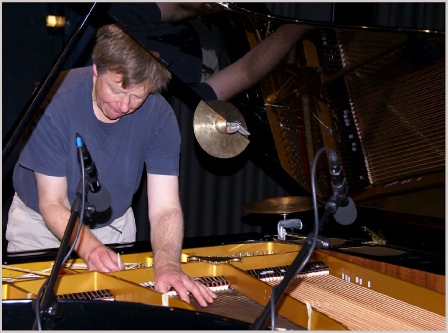
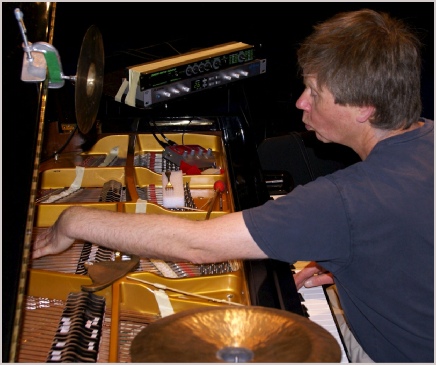
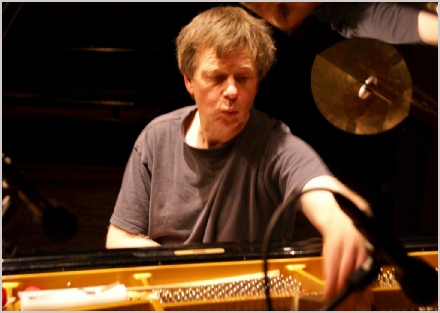
To be honest I was trying to escape from keyboard playing. I got to a stage where truly, I didn't want to play one single note of conventionally articulated piano sound. (Conversely I remember John Butcher saying it is important not to deny the true nature of the instrument.) Whilst in the early days I tried in my keyboard playing to sound like McCoy Tyner, Keith Tippett or Cecil Taylor, I failed to find any sense of individuality by pursuing what was essentially hero worship/pastiche. So I went inside and worked on the strings. Interestingly in my mind I made little connection with Cage's prepared piano. Mine was, and has remained, unprepared(!), working directly on the strings with real-time manipulation. Early on, John Butcher, John Corbett, myself and others were rehearsing at the Workers Music Association off Westbourne Park Road in London. They had a big old grand piano - a Bluthner I think - and I always had the lid open. I started working directly on the strings, at first mixing keyboard and inside work then later working almost exclusively on the strings. Trumpeter John Corbett had also been fond of subverting my keyboard playing by throwing objects onto the strings whilst I played.
In recent years it has been relatively easy for me to introduce some electronics into my work; the way I use effects units is very similar to the way I manipulate the strings of the instrument. Incidentally, still, to this day if the sound of a conventionally struck piano note escapes when I am working on the strings I think of it as a mistake. However as I indicate above, I have re-introduced the conventionally played piano sounds into my work, albeit with uncommon keyboard techniques.
The piano has a formidable history as the dominant instrument within western music for most of the past 300 years. Do you ever find this heavy weight of history and tradition daunting when you sit down to make music?
No, I don't have that problem in an aesthetic sense. I certainly don't feel steeped in 300 years of keyboard repertoire, though occasionally I find myself throwing in a small quote from something or other. In fact I think my pianism owes more to jazz pianists and jazz trumpeters than it does to the so called classical tradition. (Influence or passion?)
My main worry, however, is will the piano technician approve of what I do? I always check with the owner or technician before I mark up the piano prior to playing. Over the years I have tried to make my playing techniques as piano-friendly as possible and by and large they are. I try and steer clear of new Steinways etc as they make me nervous. I guess what concerns me is that here is a hugely expensive instrument that has been honed for the performance of 19th century music and they won't want me fiddling with its innards. (Cowell drew gasps from the audience when he went inside.) As it happens I prefer older, smaller, grand or baby grand pianos; though John Butcher always likes me working with large pianos for the richness of the harmonics. If the promoter is really unhappy about inside playing then I stay on the keyboard and work with other material.
You – along with John Butcher, Phil Durrant, John Russell, Phil Wachsmann etc - belong to what I still think of as an interim generation within UK improvisation; younger than the pioneers
from the 60's, but older than the generation of the so-called New London Silence (Rhodri Davies, Mark Wastell etc). A few years ago at a time when there was a certain tension between generations you seemed to be able to play with both older and younger improvisers, and included both within Ensemble. Do you see yourself as straddling two different approaches to improvisation, or is this too simplistic a notion?
It's a difficult one this because as improvisers you work with many musicians in a variety of contexts; you probably adapt your playing for each situation and generally I am very happy to do so. It is not uncommon for groups to favour a particular way of working to the exclusion of others. Initially I was enthusiastic to work in Assumed Possibilities - Rhodri Davies, Mark Wastell and Phil Durrant, all musicians who had played with Ensemble - and particularly enjoyed the second CD. However there came a time when these enthusiasms deserted me and I actually felt uncomfortable with the more rigorous approach they had taken. For me it had become far too mannered, perhaps even didactic. This was now a music that in fact, I felt very distanced from. So I resigned - and felt much better for it. (And I am sure this was the best course of action for the others.)
This did raise in my mind the whole question of how far one is prepared to adapt ones own playing to fit in with different musical settings. Indeed, can there be a value in working in situations that are way outside your usual areas of performance? Chameleon or maverick? With Assumed Possibilities it was a sensitive issue and a difficult one, particularly when long standing friendships seem to exacerbate the problem.
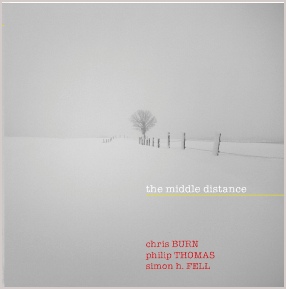
How did the Middle Distance trio with Simon Fell and Philip Thomas come about? Had you played as a trio before the recording session?
We hadn't played as a trio, but Simon and myself had performed a short duo on Phil Thomas's Comprovisation festival in Sheffield. We wanted to further this work and the opportunity came to record for Another Timbre. A trio was requested and Simon suggested we work with Phil Thomas. An inspired choice. The lunchtime concert prior to the recording session was the inaugural meeting of the group; prior to this Phil had worked with both of us, performing compositions of ours and playing in a large festival group.
Have you often played with another pianist and did it present any problems? Is it something you would do again?
This session presented no problems such as those sometimes encountered when similar instruments play together. In fact I had little idea as to what Phil's approach was to be until I saw that his designated piano had been substantially prepared. This was a masterstroke as it immediately defined and separated the sound of the two instruments. And of course Phil is a skilled interpreter of Cage and is used to working with preparations. Certainly it is something I would love to do again.
Playing with another pianist has been a very occasional pursuit for obvious reasons; however I do remember a four hands at one piano I performed with Veryan Weston at the Red Rose. Quite a theatrical performance, and very enjoyable.
Do you manage to earn a living from music, or do you need to hold down a day job?
Music is all I do but my work has always included some music teaching.